
Like most TADs I’ve spent a lot ot time over the years thinking, brainstorming in seminars, and commiserating with other ministry staff about how to “engage more of the church family in serving opportunities available at our church.” (recruiting volunteers)
This weekend I had a very unique and interesting opportunity to speak about Technical Arts to the whole congregation at each of our 3 services. I had 6-8 minutes and, like most ministry leaders, I only used 10:32 of it. (my bad.) So how did I get platform time and what did I do with it?
About 10 months ago, we started, as a team, intentionally advancing the vision for a multi-site campus we plan to open 20 miles away around Easter 2012. The original idea was to do a 10- minute discussion called Heartbeat of The Chapel at the top of several consecuative services. During these segments our lead pastor and one of our associate pastors would do an interview type chat to roll out details and decisions regarding the undertaking. These chats and updates would be video captured to YouTube for public consumption allowing those outside our weekend services, and in the adjacent community, to hear our heart, vision, and intent – as it pertains to opening an extension of our current campus.
After several episodes, the idea surfaced to set-up these types of talks as part of a volunteer “highlight” series that would feature the faces and stories of those serving in different ministries. These would teach the congregation about the various ministries and the amount of people it takes to perform them well. It also provided a platform to discuss current and additional needs that will be created both at our campus and at the 2nd campus when it opens.
Technical Arts was the last ministry to be featured. It was originally combined with worship team (as tech often is) and we were going to divide the 8 minutes between the two ministries. Timing considerations over the past several weeks allowed the separation of the two and they got their own date/ time slot. (cha-ching)
The approach I took was to divide the segment into 3 sections: view interview here: http://youtu.be/CeB6t86m34Q
- How and Why is Technical Arts important in a church? (there’s always been “technology”)
- What Technical Arts is and what it’s not. (AVL as opposed to IT or computer sciences) (communications not “entertainment”) Also our church is not Pastor centric nor do we have a television ministry as part of our mission.
- What type of person is attracted to serving in Technical Arts and what are next steps to learn more/ make contact. (this did not feature an interview but I did share stories of two of our technicians and some common characteristics I’ve observed over the years.)
The first section talked about the bible’s reference to the use of the “technologies of the day”. Jesus speaking to large crowds – leveraging mountainsides, elevation, and daylight to communicate. How in John 8 he wrote in the dust with his finger. Later the technology of stained glass to remember and to visually share the birth, resurrection, and gospel to crowds who were probably much less literate and educated than in today’s culture. The use of architecture and hard reverberant rooms to focus and distribute speech. And even the more modern technology of printing/ re-printing words on paper, organized, and bound between 2 covers. Up to the electronic media used commonly in today’s culture.
The 2nd was a teaching time about Technical Arts. After outlining the 6 “behind the scenes” volunteer functinos that interact and communicate during all parts of a service or event (not just worship music), we cut all the sound, lights, and projection in the auditorium. Literally, in the dark I asked the audience of 650 (without the aid of a microphone) to imagine trying to do worship or listen to a 40 minute message under these conditions. I then individually asked each technician to bring up their respective devices as if we were talking on clear com.
After each service, I had several people approach me in the atrium and say something like “I had no idea a team even did this. I just thought there was a “sound guy” in the back who flipped some switch and it all just worked.”
Additionally, I received 9 contacts from people wanting to get involved. Some with no experience who want to learn, to someone who used to be a TD (with digital console experience) in a similar church before moving to our area.
Now this is in no way a magic bullet, but I’m convnced that casting clear vision and mission is critical to finding willing people to serve in any ministry.
Now if I would have approached the leadership about having 10 minutes of a service to talk tech, the idea probably wouldn’t have gotten very far very fast. Instead this opportunity evolved over months of brainstorming and discussion about things much bigger than just technical arts. When the time arrived, I felt God calling me to use those precious minutes to teach the congregation about our vision and values as a church in general and as a tech team in particular. I had to invite people to something that matters. This wasn’t about “begging for help.”
The fact that leadership provided a platform to cast this vision to the church as a whole made the ministry legitimate and important in the eyes of the congregation. At least for the time being, everyone in our church knows what role Technical Arts plays in preaching, teaching, and worship – not only for weekend services but in student ministries and small groups activities as well. I’m blessed to work with a great team lead by great leaders.
Just read a tweet from a fellow tech director about taking a fall and is dealing with some severe pain today.
It reminded me that during this time of production, time of chaotic and rushed rehearsal schedules, modified stage and building set-ups, or the use of ladders, lifts and other equipment. It’s important to remind each other to be careful. Check to see if the breaker is off. Take some time.
Often our Christmas programs involve light cues that are dim and may even blackout during transitions. We have additionial volunteers who may be new and unfamiliar with the stage and room arrangements. There may be more crowded green room areas and oddly cabled stages. There may be guest artists who are not familiar with where things are such as steps etc. – that our regular teams take for granted. Regular band members and singers may be in different stage positions with additional gear and other obstacles they normally don’t encounter.
Since we are most likely to be intimately aware of conditions and modifications, we have a responsiblity to gently instruct, guide, and remind our platform artists and guests about how to safely manuever around our environments. We need to serve in this capacity.
We have a responsiblity to gently instruct, guide, and remind our platform artists and guests about how to safely manuever around our environments.
And while we’re at it we need be careful and alert ourselves also. Being a technical director means we often have our eyes, ears, and attention on many things during the course of fabrication, rehearsals, production, and striking. There’s always multiple balls in the air during a program.
Being a technical director means we often have our eyes, ears, and attention on many things…
Praying for a safe, enjoyable, and fruitful Christmas production season for all my technical friends.
Oh yeh, and allow yourself some basic boundaries:
- don’t forget to eat,
- swing by the house and say hi to your family
- and SLEEP (or find a place to squeeze in a nap once in a while if necessary.)
It’ll do your spiritual and physical health good! You’ll be a better team player and a better leader at work and at home.
Blessings.
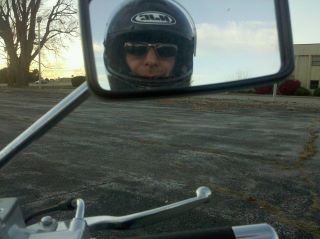
- This Tech Guy’s View of South Campus.
So last Sunday I found myself trying to sneak in what possibly was the last motorcycle ride of the season in northern Ohio. The air was crisp and refreshing. After meandering around the countryside for about 30 miles, I stumbled on the road that lead directly to the location of our proposed multisite campus in Norwalk. With a little daylight left, I decided to swing by to contemplate, to dream a little, and to pray.
-
It’s fresh and new.
-
I get to research new sound and video gear and take on the challenge of balancing quality with the reality of limited budgets.
-
I get to work with some amazing volunteers and staff – engineers, architects, consultants. To be a part of something very unique in this area.
-
And if I’m honest, there’s some pride that creeps in knowing that I’m a part of something pretty amazing that not many people get to experience in a lifetime.
So if it’s not the building and it’s not the experience of being a part of a creative process then what does this all mean? Why do any of it? To put things in perspective for me I had to consider the following:
Nationwide 80% of the population does not have a church home or have any connection with church beyond a Christmas/Easter visit.
Erie County – (with a population of 78,000) approx. 62,000 people are not exploring, beginning, or growing in a relationship with Christ.
Huron County – 48,000 out of 60,000 are not connected to a church home.
Ottawa County – 32,000 out of 41,000 re not connected to a church home.
This means that despite all of the churches within 30-minutes our home there are approximately 140,000 people who are not connected with a church family in any meaningful way.
So why build a multisite church?
I deeply and genuinely believe people matter to God. And that a meaningful relationship with Jesus is essential to living a healthy, purposeful, hope-filled existence here on Earth and thru some, amazing super-natural, way promises an everlasting life beyond the grave as a result of something as simple as Grace and Faith.
If anyone asks you,
‘Why are you doing this?’ say, ‘The Lord needs it…
So what’s your vision?
–
About a month or so ago we announced, at a Wednesday night rehearsal, that we hired a part-time technical director to assist me. Our lighting programmer/ operator, Frank, looked at me, smiled, and thru a few tears of joy told me how he and his wife had been praying for over a year that the right person would step up at the right time. He was genuinely joyful that God provided for our ministry and our team. Frank had not only been a capable and dependable lighting tech, but he genuinely cared for me, my work load, our team, and our ministry as a whole.
This past weekend, my friend Frank approached me after service and (with shakey voice and a few tears) proceeded to tell me that he was recently assigned to the night shift and will be working primarily weekends. And that he couldn’t make rehearsals or weekend services for an indefinite amount of time. He appeared heartbroken. Not just that he couldn’t serve at something he loved being a part of, but he just couldn’t find a way to avoid breaking the news to me. He was torn. It was sad.
Now I’m sure God will provide another servant to learn to program lights and become a part of our team. And ministry will continue. We can teach skills. But Franks humble spirit and heart for serving, in whatever capacity needed, was a precious and valuable gift. Serving with Frank is a joy and I’m sure at some point God will choose to re-arrange his work schedule and he’ll back in full-swing, doing what he loves to do for the Kingdom.
Last week I had the opportunity to attend a 1-day meeting in San Diego with about 70 Technical Arts Directors from around the country. It was refreshing. Unlike many church conferences, there were no vendors trying to sell stuff, no breakout sessions (often led by vendor reps trying to demo stuff), and the thrust of the discussions didn’t involve gear or process. It was all about ministry.
What we did talk about was why we do what we do. It was challenging, convicting, and encouraging.
At the end of the day we walked away with 3 goals:
- -to move technical arts toward being a “driving force” in leading people to a relationship with Christ and transformed lives.
- -to become spectacular in 360 degree leadership. (to properly influence upward, downward, and across)
- -to view our role within the context of God’s plan (TA is a ministry not a department.) We all play a small role in God’s big story. (It’s not our job to create our own story.)
Our technical ministries will land somewhere between that of a “technical janitor” and that of a “driving force” for ministry. Where are you on that continuum? How can you move it forward starting now?
Our technical ministries will land somewhere between that of a “technical janitor” and that of a “driving force” for ministry.
Does what we do as technical artists and directors lead people closer to Christ? Does it play a role in transformed lives? Or do we merely act as stage managers for a one-room rock show each week?

 What Matters Matters