

If you have worked in a non-profit organization like a civic club or church that operates primarily with volunteers, you have no doubt participated in discussions (and lost sleep) over how to better recruit, why willing people are scarce (the 20/80 rule?), or why volunteers easily leave or fail to show up consistently. And you may find yourself circling back around to some generic answers to the same question you think potential prospects must obviously have: “what’s in it for me?” You then assemble a variation of the same list of ideas your organization has probably developed each year for the past 30 years – typically with the same insufficient and frustrating results. You conclude the answer, of course, must be benefits, right?
I imagine most people already know that the benefits of volunteering include fun, community, meet and make friends, free coffee, self-gratification for doing something good, fun, relationships, free pizza, positive public exposure, networking and of course more fun. But often there is only a glimpse of the actual result and impact of the volunteering effort itself contained in the messaging. It’s almost as if the purpose of your organization is an afterthought or some coincidental outcome that hopefully happens if you can just keep people satisfied, happy, and entertained.
Next someone probably develops a one-off pitch with printed materials highlighting the need for help and featuring the many personal “rewards” of getting involved. It maybe gets featured in some brief public announcement or more often couched in a passionate plea of desperation. Maybe there’s even a little shame, guilt, and a challenge to duty sprinkled in just to make the offer compelling.
The campaign might get pitched once or twice – maybe in conjunction with a fair or showcase event once every couple of years. Then it’s rarely talked about again until the next frustration cycle or crisis hits. This strategy is just not effective recruiting, is not enough, and even misdirected.
The honest answer to the question “What’s in it for me?” is simple …nothing. Absolutely Nothing! Volunteering, by definition after all, is not a transactional relationship for reward. Don’t make it one.
Stop selling the benefits. Instead get serious and creative about developing meaningful opportunities for others to live beyond their selves when attracting and onboarding new participants. Instead, paint a compelling picture of how this role matters to someone else. Impress how the role can fit into a bigger plan and significantly change the lives or circumstances of others. This must be a team effort. Get your entire organization on board with the messaging. Ignite a passion for the mission or cause, especially if you’re trying to develop a high performance team of volunteers. Unless it’s a simple group project that doesn’t recur, don’t “recruit” volunteers. [Are you leading a team or a group?] Instead, identify and enroll people into the best roles for the right reasons based on compelling vision. Discuss how the organizational mission or cause may have profoundly impacted them or someone they love. The process and message must remain ongoing since volunteer teams are naturally organic and continuously changing. The strategy needs to get baked into your organization’s language and culture.
Benefits will still be there. It’s not that the benefits don’t exist or are unimportant. In fact, they’re absolutely critical to get right and execute well – just don’t lead with them as the primary value of the effort. Don’t cheapen a noble call to action with gimmicks. You see, benefits focus is still transactional. Mission focus, on the other hand, is transformational. People who fall in love with the purpose and mission will still experience the friendships, community, and all the signs of appreciation you can facilitate and lavish on them. The encouragement texts, thank you notes, care calls, free coffee, motivational and team building events, personal helps, fun, even public exposure are very important to encouraging and retaining people. Nurture a community culture. The difference is that their heart and mind will be aligned with others around advancing a purposeful mission and they will more likely be deeply invested for the long haul. People who are solely in it for the transactional will consistently fail to show up once something more important, convenient, (or fun) comes up. Or when they get challenged by an operational adjustment, disappointed by some natural change in leadership, community, or experience a shift in their relationships with others.
“Coincidentally, Gen Z is noticeably more self-actualizing and increasingly values purpose, experience, and mental health more than just a paycheck or reward. In our postmodern digital environment, many people, ranging from Boomers to Gen Z, are prioritizing experiences over material gratifications.”
– Gary L. Yonek
Never lose sight of the fact that volunteering is a sacrifice, a gift, an offering of people’s time, heart, mind, and resources. (They don’t owe you or your organization anything.) No matter what the role is, it costs them something. It costs their family something. Don’t ever minimize or trivialize that, pretend it’s irrelevant, or take it for granted. Acknowledge and honor their effort. Because it matters …a lot.
…benefits are still transactional. Mission on the other hand is transformational.
Gary L. Yonek
It takes intentional effort and resources to communicate and ignite a passion for a worthwhile mission/cause and shift your focus from the transactional to the transformational power of inspiring and empowering volunteers. Volunteers are not “free labor” and building high-functional teams is not always easy or cheap. The strategy must be intentional, organizationally integrated, and ongoing.
Develop the kind of organization, mission, and team that others would cheerfully and willfully give their time – even if the role is hard and there were no rewards whatsoever. Imagine having a purpose so compelling and opportunities so significant and meaningful that people would line up at the door, take a number to be next, and arrange their personal schedules for even the chance to be involved. Yeah, it’s really hard but let’s shoot for that!
For some time now I’ve been thinking about how the dominance and oversaturation of printed words gradually (almost imperceivably) diminished compassion, feelings, and empathy in exchange for elevated literacy and logic over the course of the modern age.
Back in a day when information was more manageable, print technology brought unity, understanding, and knowledge in addition to creating margin, that allowed time for more thoughtful consideration and civility. As literacy and education grew and spread, these traits replaced the impulsive and seemingly irrational, less civilized behaviors found in more oral traditions. (Pre 1500s)
During the late 1800s and thru the 1900s that valuable margin began to erode. And by the end of 20th century, the healthy time gap between learning, understanding, and response all but disappeared. A giant print industry along with the advent of various electronic technologies took our literal minds to a new unexplored level. The pace of life accelerated. Although the incremental increases in the speed of communications began to compress our world, information was, for the most part, still unified and dependable. Increased speed brought great advancements with increased efficiency and production, along with expectations of faster response and resolution to questions and concerns – swift logical conclusions to complex and often emotional challenges. In short, less patience and consequently less concern for others became the norm due to the efficiency and automated characteristics of developing media.
The beginnings of a technological induced anxiety that would soon reach a level extreme enough to influence sociological behaviors emerged.
Around 2005, something historically significant began to evolve. After about 400 years of the printed word being the dominant communication medium, suddenly it was not. (You may be old enough to recall owning 26 volume sets of family encyclopedias or seeing 3″ thick metropolitan Yellow-page phone directories in hotel rooms.)
Digital communications and digital information changed not just how we interact but how we collectively behave. It quickly took what I refer to as the hyper-literacy of the over-extended print medium to a staggering new level. One that further repressed feelings, emotion, and empathy exponentially. (We didn’t become illiterate, but our sociological behaviors began to appear more reflective of those seen in pre-modern oral and tribal cultures, as post modernism became reality.)
We lost nuance and context that was the revolutionary hallmark of early print technology and the foundation of more civil literate societies. The west was born and democracy flourished. The US became the first government in world history to designed and birthed from a written, printed document.
Two Conditions Collide:
2005. For the first time in human history, we were able to have bi-directional, synchronized audible and visual communication, around the globe, seemingly at instantaneous speeds. In other words, although we can continue to improve the quality of sound and visuals, there will be no more meaninful increase in speed or reach of communications. Unlike with early print, there is little mental and emotional margin left to contemplate and consider options, cool off, reduce anger, diffuse tensions, resolve conflict or seek advice with discourse when making critical decisions. The constant expectation of immediate response, action, and results is becoming progressively more oppressively life-sucking.
The second result of the digital medium is the ability to access information about most anything at anytime from anywhere. Information is basically limitless, and accuracy is sometimes questionable at best. There’s a loss of reliability in much of what we read, see and hear. Information is no longer linear and stable. It can be intercepted from several sources simultaneously, and in random sequences. Information is absolutely abundant but can also be untrustworthy or maliciously corrupted at times.
The Result:
The result of these two realities is that humanity has quickly reached a maximum limit to the speed at which it can communicate and is reaching a point of endless quantity of available data. Some information is useful and applicable but most is unneeded or irrelevant to us individually.
The human head and heart, as conditioned by several centuries of enlightened modernism, simply cannot consume and discern the onslaught of information and digital media stimulation that we now have access to. Combined with years of repressed emotional empathy thru the 20th century, it’s evident that people, in general, are now acting out more impulsively, with less civility, and sometimes even violently with little or no external prompting. Even otherwise thoughtful and considerate individuals seem to have reached their capacity to care and generally be kind to others beyond their immediate families. Many of us are now generally more critical, cynical, sarcastic, inward focused, and feel the freedom and need to immediately respond pointedly and oponionate carelessly without shame or filter.
Merely navigating daily life in this post modern time is inherently stressful and depletes us emotionally and mentally.
This technological state is now the societal norm. It is the reality and experience that the hearts and minds of those born after 1990 will be predominantly conditioned by moving forward. It is the technological environment that will influence the development of their identity and core personal value in their formative years. They never will have known or experienced another way with which to compare and contrast.
So how does our culture regain a more global sense of care and compassion in our post modern times?
I think one key is to somehow ignite a passion in others to live beyond self. To find their identity and a core value in diverse activities greater than just their role or skills. To instill a sense of gratitude and thankfulness that leads to a sense of selflessness.
That, along with a little healthy vulnerability, self awareness and a regained sense of thoughtfullnes, can go a long way to improving confidence and reducing anxiety and fear which can cripple compassion, empathy, and kindness.
I’ve often heard leaders in volunteer driven organizations lament that only 20% of the people do 80% of the work. I don’t know if this is really accurate, but I’ve heard it as long as I can remember. It can often be nothing more than a convenient reason for throwing up hands or not seriously prioritizing or resourcing the volunteer strategy – as if that is just the way it is. But does it have to be? Why?
From civic clubs, to schools, to churches, to community centers and health care, the implication is that people just don’t want to step up and help anymore. Now let’s assume the above “statistic” is even accurate (and it can certainly feel that way sometimes), then isn’t it a pretty sad excuse for not taking the initiative to look at volunteerism differently?
Seriously though, admitting that 80% of participants, connected to your organization, are little more than casual names in a group speaks to 1 of two possible realities regarding your organizational leadership:
1. Either the organization’s ability and priority to communicate a clear compelling vision along with a practical on-ramp is grossly insufficient, and maybe even misdirected or…
2. The mission of the organization is simply not meaningful or purposeful enough to engage more than a small amount of enthusiastic stakeholders (often the founders or decedents of the effort). In other words, the organization itself may not genuinely believe in it’s mission any longer, fails to intentionally resource the mission, or maybe even lacked a meaningful purpose to begin with.
In my upcoming book Welcome Aboard (shifting your volunteer strategy from transactional to transformational) we’ll look at why people volunteer, and how to package your vision and mission in such a way that brings fresh life to the experience in 2024 and beyond.
If you function in or lead an organization that wants to get serious about volunteer engagement, I’d like to hear from you.
#welcomeaboard
#whatmattersmatters
#leadership
#culture
#volunteerdevelopment
http://www.linkedin.com/in/gary-yonek
Follow me on LinkedIn: https://linkedin.com/comm/mynetwork/discovery-see-all?usecase=PEOPLE_FOLLOWS&followMember=gary-yonek
Occasionally I’ll hear someone speak about “these modern times”, when what we’re actually living in are the “post-modern times” – and we have been for about 15 years.
For over 400 years the modern era was marked largely by the printing press as the single dominant communication medium and profoundly shaped the linear literary mind especially in Europe and the West.
Many agree that post modern times began around 1970-1980 (some even say the late 1800s with the introduction of the telegraph). The Digital Communication Age, however came into full effect around 2005, significantly and noticibly changing cultural behaviors and attitudes.
The post modern mind is now largely shaped by current electronic technologies, specifically the fast dominance of digital communications as primary communication media.
Although, in the west, we still technically live and operate as a written, literate society, physical print is no longer the dominant medium. It’s simply not the reality any longer.
Consequently, our collective insensitive, sometimes violent, conduct and impulsive, sometimes irrational responses to our surroundings reflect that of more an oral, tribal tradition than that of a literary society. And those seem to be just a few of the behavioral characteristics of the digital communication age. What are some others?
This is our reality. And this will enevitably have to factor into the way we lead others and build teams moving forward.
What notable cultural or behavioral shifts have you experienced or observed beginning in 2005?
#postmodern #communication #media #digital #printing #culture
#whatmattersmatters #leadership #understandingthetimes
#tribes #teams #leadforward
9-16-2025 by Gary L. Yonek
It was early Sunday morning. A beautiful sunrise over the calm bay with a hint of fog welcomed me to town. I was still sleepy but the coffee was helping and the teams I was responsible for began walking in.
That’s when I encountered Belinda. She was just the most kind, present, cheerful, person who, even before any guests arrived, was in position – and she set the tone for our entire morning. It was quite simply thoughtful kindness. Her relaxed peaceful attitude was contagious among the staff and other volunteers hustling about to get their morning ready.
Belinda and our first impressions team were on point, making everyone in their sights a top priority. They’re all volunteers, tasked with welcoming and assisting anyone who needs anything. (Hospitality is intentional and critically important.)
I told her thanks for serving and without hesitation she cheerfully replied:
I’m not a morning person but I don’t mind getting up early to be here. In fact “this is the only thing I actually set my alarm for, I love being a part of this”.
It’s truly inspiring to witness someone transform from:
- I think I should do something (or it’d be nice to help out), to…
- I need to do something, to…
- I like to do this, to…
- I want to do this, to…
- I GET to do this!
For them, volunteering and selflessly serving someone else is not transactional, it’s transformational. It’s something they feel is totally worth their sacrifice of time and energy with no material reward. It’s a genuine passion for meaningful mission aligned with a love for others. It’s living beyond self. That is transformational both for them and everyone they serve. When you encounter someone serving beyond their self you get a clear sense that they aren’t there out of some sense of duty, guilt, or obligation. And they’re also not there solely for the personal satisfaction of doing something good or enjoying relational connections.
“this is the only thing I actually set my alarm for, I love being a part of this”
Belinda is one of several hundred volunteers at our church who have moved from a weekly spectator to an engaged participant.
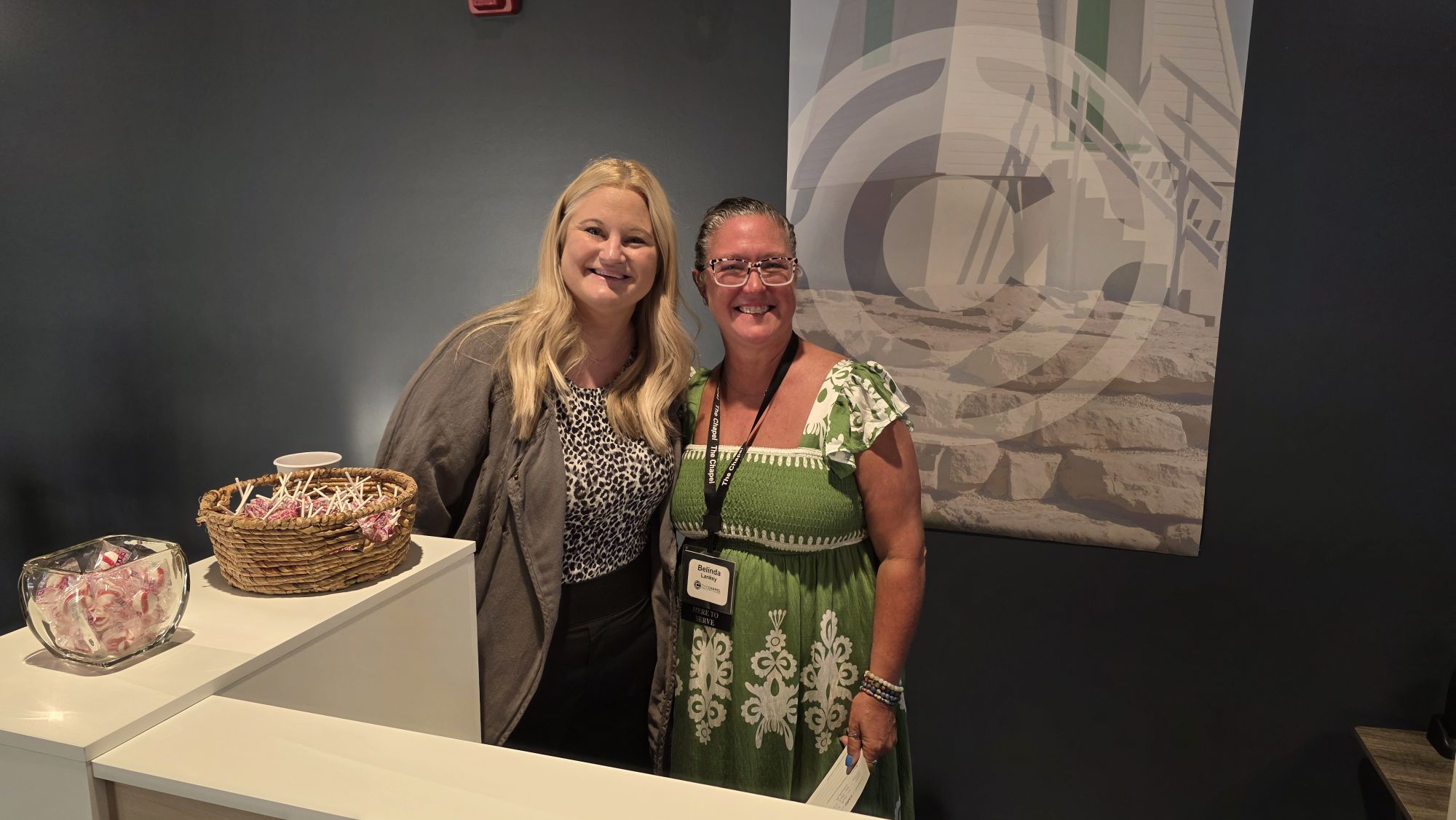
I get to work with some amazing leaders at The Chapel. And our director of engagement Brittney Wadsworth (pictured here with Belinda from our first impressions team at our Port Clinton campus) is at the top of that list.

by Gary L. Yonek
For some time now, I’ve reflected on how the dominance and oversaturation of the written word have subtly diminished compassion and empathy. While literacy and logic have flourished over the modern era, our ability to feel deeply and connect meaningfully has slowly suffered.
The Evolution of Communication and Empathy
In earlier times, when information was more manageable, print technology fostered unity, understanding, and knowledge. The time gap between receiving, processing, and responding to information allowed for greater thoughtfulness and civility. The rise of literacy replaced the impulsive and often irrational behaviors seen in oral traditions, leading to a more structured, rational, and civilized society.
However, by the late 1800s and into the 1900s, this valuable margin of reflection began to erode. The acceleration of life, propelled by mass print and electronic media, compressed our world and expectations. The demand for faster responses and swift conclusions to complex, often emotional, challenges became the norm. Efficiency took precedence over patience, and with it, a decline in concern for others emerged.
The Digital Disruption
Around 2005, another major shift occurred: after about 400 years, the printed word was no longer the dominant medium of communication. Digital technology transformed how we interact, moving us into an era of seemingly instant and limitless information. This transition did not lead to illiteracy, as some feared, but rather to a postmodern reality where sociological behaviors began to resemble pre-modern, tribal/oral cultures. (Few could argue that humans weren’t generally less civilized before the enlightenment period.)
While early print technology introduced nuance and context that nurtured civil, literate societies, digital communication disrupted that balance. Information became abundant and easily accessible but also more unreliable, non-linear, easily edited and often updated, and fragmented. Instantaneous, bi-directional communication eliminated the mental and emotional space once available for discourse and contemplation. This has fueled anxiety, stress, and an expectation of immediate action, often at the expense of empathy and kindness.
The Consequences
Today, we exist in a world where the speed of communication has reached its physical limit, the volume of available information is practically infinite, and the reach of communication no longer has any practical earthly boundary. The human mind, conditioned by centuries of modernism, struggles to process and discern the barrage of digital stimuli. In turn many people have become more critical, cynical, and inward-focused, reacting impulsively and with diminished concern for others. The social climate has shifted toward impatience, polarization, and emotional depletion.
For those born after 1990, this digital reality is all they have ever known. Their formative years have been shaped by an environment of constant connectivity, forming their identities and values in ways that differ significantly from all previous generations. The challenge now is how to restore a broader sense of care and compassion in this postmodern era.
Reclaiming Kindness in a Digital World
Regaining a culture of kindness requires a shift in mindset. We must inspire people to look beyond themselves, to find identity and purpose in diverse, meaningful activities beyond professional roles or digital personas. Gratitude and self-awareness are key in cultivating a sense of selflessness, reducing anxiety, and fostering genuine connection.
By embracing vulnerability and thoughtfulness, we can rebuild confidence and resilience, counteracting the fear and stress that often hinder kindness and empathy. If we can create spaces—both online and offline—that encourage reflection, patience, and meaningful engagement, we can begin to restore a more compassionate world.
Call to Action: Let’s commit to intentional kindness. Not just to act kind but to become kinder beings. Whether it’s pausing before responding, seeking to understand before judging, or expressing gratitude, small shifts in behavior can have a profound impact in an age dominated by digital immediacy. Ground your identity in something beyond your self. Find a meaningful cause or value then volunteer your time and resources – for no reward than to serve someone or something other than yourself. Seek the divine and intentionally live a life where you are less the center of your own universe – then watch your world, and your “self”, transform right before your own eyes.

Identifying and Enrolling individuals to your team is about much more than just advertising openings or needs, and making room for relational community.
by Gary L. Yonek 2-8-2025
For as long as I can remember leaders, particularly in volunteer-driven organizations, have often expressed a similar lament: “20% of the people do 80% of the work.” Maybe that’s true. Or maybe it’s just an excuse—an easy way to justify the status quo instead of prioritizing and resourcing a serious volunteer or team development strategy.
But does it have to be this way?
From civic clubs and schools to churches, community centers, and healthcare organizations, the assumption is that people just don’t step up like they used to. But let’s challenge that assumption. If 80% of your stakeholders, or consumers, are little more than a list of names in a group (instead of mobilized teams), what does that say about your leadership and organizational culture?
It likely points to one of two realities:
1️⃣ Your organization isn’t communicating a compelling enough vision or providing a clear on-ramp for engagement. If people don’t know how to get involved AND why it matters, they won’t.
2️⃣ The mission itself isn’t resonating. If only a small, passionate group keeps things running, is it because the organization no longer believes in its mission—or maybe never had a strong one to begin with?
Are you a mission-driven leader? If you lead or support an organization struggling with volunteer involvement, let’s start a conversation. Your mission matters—but does it matter enough?
Gary L. Yonek
Let’s Think About It…
1️⃣ If 80% of interested people aren’t actively engaging in your efforts, is that a people problem—or a mission problem?
2️⃣ Are you still trying to recruit volunteers… or just hoping they’ll magically show up? A clear vision and an intentional enrollment strategy make all the difference.
3️⃣ If your organization disappeared tomorrow, who would miss it? If the answer isn’t clear, neither is your mission. (You can’t package and envision something you cannot define and articulate.)
4️⃣ People commit to what they believe in. If they aren’t showing up, ask yourself: Are we providing meaningful activities that provide them something that’s worth showing up for? This requires taking a serious honest reflection of what your organization does and what that mission stands for. (Many may intermittently hang around and benefit from the relationships and community of an organization, but few will waste their time and energy advancing something, deep down, they believe doesn’t really matter.)
5️⃣ Is your volunteer strategy transactional or transformational? The difference determines whether people either get on-board, stick around and engage, or remain on the side lines and drift away.
In my upcoming book, Welcome Aboard: Shifting Your Team Strategy from Transactional to Transformational, I explore why people step-up and how organizations can better reframe their mission, systems, and process in a way that reignites engagement and inspires genuine commitment.
📩 Let’s connect: http://www.linkedin.com/in/gary-yonek
Many of us, especially in the current postmodern Evangelical Christian movement, have taken “righteous” anger and added disgust, resulting in contempt. As Arthur C. Brooks points out, “contempt is the conviction of the worthlessness of another”.
We would never call it hate but contempt is foundational to hate.
Whatever our position on something is, we would never say we hated the “other side”. That would not be “Christian” or Christ like. However, it seems like many might say they “love” their neighbor (but hate the sin), while holding up some righteous indignation (outrage) to qualify and validate their contempt (disgust) for another’s personhood (hate). To “speak truth in love” with contempt is impossible, so for integrity sake at least take responsibility and call it what it actually is, hate.
Jesus never displayed contempt or hate toward anyone even when addressing sin. EVER.
I don’t know that one can talk or reason another out of contempt. It’s a belief ground in feeling of fear or need to control, and not something logical to be debated. Therefore it’s not about “absolute truth” or biblical inerrancy. It is about hate, and anyone claiming to be a Christian should calmly, immediately, and unapologetically name it and challenge it when we encounter it within ourselves and our own sphere of valued relationships.
Because if love and grace were genuinely at the core of one’s being, then contempt would not be an issue. It simply couldn’t be. I’m convinced we have a contempt problem in our culture and churches, more so than simply managing anger or resolving sociological or theological differences.
Sin is not about running a foul of some moral rule.
The word sin, translates from the Hebrew word khata, which means to miss the goal.
Jesus said the greatest commandments in all of scripture (goal) is to
1. Love God
2. Love Others.
Contempt (hate) misses both of those. That is literally the essence of biblical sin.

 What Matters Matters