
My son Zach and I were part of a 10-member leadership team that visited the impoverished country of Burundi in Africa. Our main responsibility was to film and document the activities and observations of our trip into the remote up-country village of Bugenyuzi. Our goal was to bring back a comprehensive story to tell our church and area leaders. The biggest considerations were how to maintain a decent quality while being as discrete and respectful to the village and people as possible. Initial review of some of the clips indicate we may have accomplished that goal.
Due to spotty and unregulated AC power, battery conservation became a continuous challenge. Basically we thought about what we needed to shoot before we powered up and took the shot. Gear was constantly powered down whenever there was nothing to shoot.
Additionally, security and transport were assessed. We wanted to be portable enough to take all the “expensive” stuff as carry on luggage and avoid checking. Not so much because things were fragile, but because where we were going it’s not uncommon for bags to get lost, or items to be taken within the airport systems. This presented some anxiety in that we did not know if we’d be questioned about the remote quadra-copter, odd looking batteries, propeller blades etc. We managed to pick up a personal effects policy with our home-owners carrier. It cost about $38.00 to cover approx. $4,000.00 of gear for 12 months. Fortunately, nothing was taken or questioned and we returned with all equipment functional and in tact.
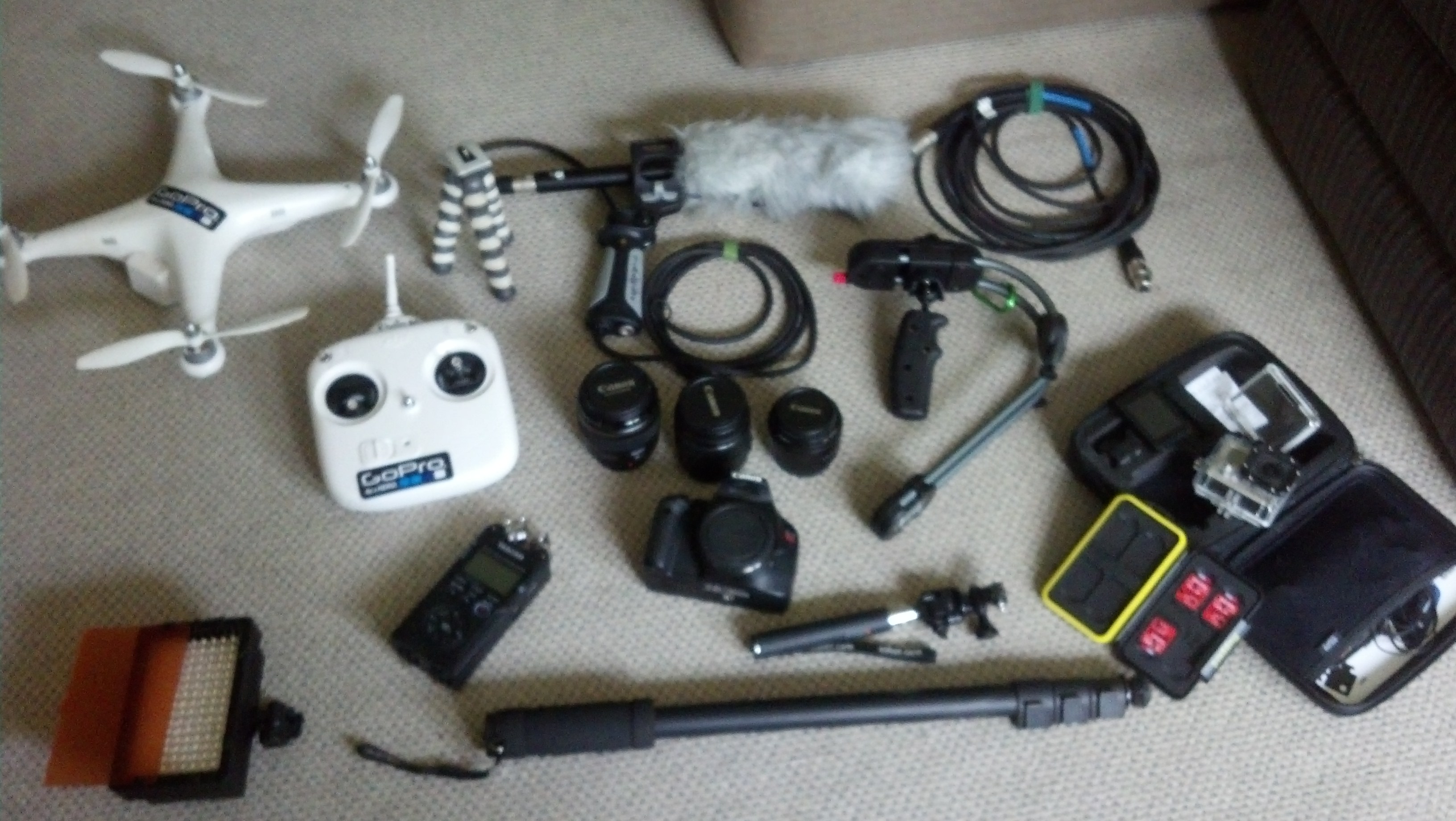
Zach shot w/ a DSLR rig and was primarily shooting close-ups and medium wide shots. (720p @ 30 fps) All his gear traveled in a backpack which he wore while shooting.
I used a GoPro rig w/ various accessories and was primarily responsible for wide, aerial, and specialty shots (setup and b-roll) . I shot in 720p/60 fps, 1080/42 fps, and 1080/30 fps and carried everything in a small carry-on suitcase. Each day I’d take the components that I thought I would need and kept everything with me in one messenger bag.
The people of this country and the village of Bugenyuzi are very kind but the reality is they’re extremely impoverished and desperate. We were cautioned repeatedly never to leave anything lying around unattended. Therefore, we had to shoot and work with all our gear on us at all times.
Here’s just a quick breakdown of the capture gear we used. If necessary we also shot stills and spontaneous video with the iPhone4, and Moto Droid Razr.
the DSLR:
- Canon T2i w/ 50 mm, 18-55 mm w/ stabilizer, and 100 mm lenses.
- Led fill light
- Colica WT 1003 monopod
- ScanDisk SD extreme high-speed memory cards. (16 Gb x 3)
- Ruggard brand SD case.
- Tascam DR-40 audio field recorder, AAA batteries.
- Sennheiser shotgun mic w/ hand grip
- Rode hand grip, windscreen, and misc. cables.
the GoPro:
- GoPro Hero 3 w/ iPad and Android Ap.
- Smoothee brand Steadicam
- xShot retractable mini pole mount.
- The ChestR camera mount by Hitcase
- ScanDisk mini-SD extreme high-speed memory cards (32 Gb x 3)
- Misc. adapters, 220V converters/ adapters, solar battery chargers.
- DjI, Phantom remote-controlled quadra-copter (for aerial shots).
Over the next several weeks we will be cataloging and meta-tagging the 800 or so clips in Adobe Bridge CS6 and editing with Premier Pro and After Effects. We plan to eventually make a full length documentary style video (about 40-minutes) in addition to 10, 7, and 4 minute variations for promotions, public speaking talks, website, small group, and church presentations.
Here is just one unedited sample clip to give you a sense of the countryside and conditions.
GOPR0112 – initial visit to Bugenuzi village (Enhanced) from Gary Yonek on Vimeo.
 During part of our stay in Burundi, Africa we had the awesome experience of sharing in a workshop for worship leaders. We spent 2 days discussing the heart of the artist type topics with about 30 worship leaders from across Bujumbura. (the capitol of Burundi). The second day included worship by one of the area worship teams and that’s where I met Willie.
Willie is a young native, maybe college age. He pulled me aside to talk about tech and gear. In fact he was the only one in the whole meeting involved with tech. Burundi, being one of the 3 poorest countries in the world, does not have a lot of resources. And then here’s Willie, graciously and cheerfully pulling together the best he could with what he had. He had a basic mixer, some old amps, and some misc. microphones (a couple of real 58s and some Chinese knock-offs). In fact this outdoor church had a couple of large speakers and even a hefty pair of sub bass. I assisted in the setup and he even asked for some mixing advice/ ideas. We traded a few chops and experiences the best we could given the noise (and the fact that I don’t speak French or Kirundi). Willie on the other hand understood my English quite well. It was a joy.
Willie had many of the same questions/ concerns/ frustrations that we all do from time to time:
- How do you serve the worship team without being demanding?
- How do you encourage the pastor to hold the mic closer without offending anyone?
- How do you get volunteers not to abandon the FOH when the band finishes and the pastor teaches.
- How do you get volunteers to pray with the team instead of constantly fiddling with stuff?
- How do you make things better with no budget and 2nd hand gear?
It all boiled down to heart, and Willie had plenty – along with a love for God and leading people in the Kingdom. He wanted to both contribute to a better worship experience and respectfully honor/ yield to leaders. (which is sometimes a delectate line to walk.) Above all he wanted to glorify God and give his best as unto the Lord.
In the short time we had I tried my best to lead like a pastor and encourage like Todd Elliot.
The only thing I could think to do on our way out is to summon a translator, pull Willie aside and pray in what kind of turned into a benediction.
I asked God to watch over Willie. I told him that he had a special calling and I thanked God that he choose Willie to champion and lead tech volunteers in his church and the surrounding impoverished area. I prayed that God would give him a heart to disciple and love those volunteers and that the tech gear and skills would come in time. I told him that there will be times when he feels terribly alone and no one understands him and his needs. In those times, not to be discouraged or loose heart (or become unkind). I prayed that he would be allowed to build a healthy relationship with his worship leader and that they would work closely/ have each other’s back as they journey thru life in this ministry.
I’d like to ask all my colleagues in the US to take just a second to pray for Willie and for those you are leading today.
Technical Arts matter. It’s how we communicate to crowds. It’s how people hear the Word. Relationships matter. It’s how we listen and do life with each other. Be a leader in relationships. -Blessings.
This is one of the key leaders who we’re looking to build a partnership with and explore relationships with a new village. One of our long term goals is to send multiple teams each year to serve and share the good news of Christ’s love in a practical and holistic way.
Yesterday, I had the opportunity to speak to a local civic club regarding a trip that I’m involved with. The more I prepared the presentation, the more I realized how important it is for any organization, church, business (large and small) and even individuals to have and keep a big picture of things.
So even though my talk involved an outreach trip to central Africa, the take away really reflected the importance of vision and goals. Below are some perspectives that I’ve acquired over the past few years.
1. I’d rather fail than succeed at something that doesn’t matter:
Sometimes we rush to just “do” something. It makes us feel better. Or we spend much time and resources accomplishing projects that, if we step back and evaluate, really didn’t change much (for us personally, our organizations, our families, or anyone else’s quality of life.) I’d rather give and work toward something that is meaningful. Not everything we do can be exciting, glamorous, or highly profitable in a materialistic sense. But everything we do should probably matter to somebody.
2. Dream and Dream Big. It costs absolutely nothing to dream:
I don’t mean just “think out of the box.” I mean evaluate your surroundings, identify real problems, and don’t be afraid to come up with huge solutions (even if common sense tells you it’s impossible.) Dreaming is abundant and free. Take time to dream and make time to dream. As organizations and committees age, it’s easy to fall into a rut or depend on what’s worked in the past and repeat. This is dangerous. Over time vision and mission can just shrivel up and die. Organizations can quickly fall into maintenance (and eventually crisis/survival) mode. Often they struggle to just stay alive long after they’ve forgotten why they exist. And who wants to be a part of that? When vision and mission gets lost, there is nothing worth while to invite new participants to.
Most people are attracted to missions that are worthwhile. I’ve found that people are more eager to join, willing to participate, and are more generous with their time and resources if the vision and goal is important, impactful, and clearly articulated. If you find that it takes increasingly more arm twisting to motivate people to join and actively participate, then maybe it’s time to seriously re-evaluate and update vision and mission then probably re-construct goals and activites. Don’t be afraid to celebrate and retire outdated, irrelevant, or ineffective activities that might be a drain on resources and roadblocks to something spectacular.
3. Create at least one BHAG (Big Hairy Audacious Goal)
OK, It’s great to dream big dreams, but only fools live there. There does come a point where dreams must get distilled into something to go after. A clear target to shoot at. It still might be huge. It still may be beyond our individual efforts or resources, but it’s identifiable. It can be articulated. What’s your BHAG? Always keep one goal that’s a little beyond your reach.
4. Never start with budget:
As important as budget is, it can kill vision and creativity if it is used early in the process. Often times we sit down in committees and look at our allowance and try to determine what can be done with a certain amount of money. Always start with vision. Take time to accurately and realistically assess problems and needs. Identify goals and activities that actually accomplish a mission. Then determine what it will take to achieve those goals so that what you do matters. When this is done, THEN evaluate approaches and options thru the reality of budget. You might find that your budget is inadequate. Do you need to raise more money? Maybe if the project is really worthwhile, you’ll eagerly sacrifice other areas in the budget to bolster the new idea. (If not, then maybe the idea isn’t so hot after all) Maybe you need to dream some more. Or maybe you need to strategically align your organization with other organizations to pool more resources to make something important happen. Or maybe the trigger shouldn’t get pulled right away – it would be more beneficial to save more cash or implement the project in phases as money comes in over time. Just don’t begin with budget and don’t start projects just for the sake of “doing something”.
In June 2013, we will be traveling with a team to Burundi, Africa to come along side the Batwa people to learn and assist them in a very practical ways.

 What Matters Matters